
Your Read is on the Way
Every Story Matters
Every Story Matters
The Hydropower Boom in Africa: A Green Energy Revolution Africa is tapping into its immense hydropower potential, ushering in an era of renewable energy. With monumental projects like Ethiopia’s Grand Ethiopian Renaissance Dam (GERD) and the Inga Dams in the Democratic Republic of Congo, the continent is gearing up to address its energy demands sustainably while driving economic growth.
Northern Kenya is a region rich in resources, cultural diversity, and strategic trade potential, yet it remains underutilized in the national development agenda.

Can AI Help cure HIV AIDS in 2025

Why Ruiru is Almost Dominating Thika in 2025

Mathare Exposed! Discover Mathare-Nairobi through an immersive ground and aerial Tour- HD

Bullet Bras Evolution || Where did Bullet Bras go to?
One year ago, the streets of Kenya exploded with resistance to a controversial Finance Bill. On June 25, 2025, citizens returned to those same streets — not just to remember, but to reignite the fire of protest. What followed was not commemoration, but confrontation.
The Kenya National Commission on Human Rights (KNCHR) released a chilling report confirming what many feared — eight people died in the violent chaos that engulfed towns and cities across the country. The dead were recorded in Machakos, Makueni, Nakuru, Kiambu, Uasin Gishu, and Nyandarua.
These deaths are not isolated events. They are part of a mounting body count tied to civic unrest and police response that has become increasingly fatal over the last year. Beneath the surface lies a dangerous cycle — protest, crackdown, silence, and repeat.
Beyond the fatalities, more than 400 individuals sustained injuries during the demonstrations. Some were hit by rubber bullets, others by batons, and many by tear gas canisters or stampedes triggered by police charges.
Eighty-three of those wounded required specialized treatment — an indicator of the severity of the confrontations. This was not a peaceful gathering gone slightly awry. It was a full-scale breakdown of civil order, met with tactics that prioritized suppression over safety.
Among the injured were not just demonstrators, but also police officers and journalists, further complicating the narrative. In the fog of protest, even those covering the events — those meant to serve as society’s eyes — became casualties.
KNCHR’s findings extended beyond the casualty figures. The Commission reported credible intelligence of organized criminal infiltration — hired groups allegedly embedded within the protests across Nairobi, Eldoret, Kisumu, Nakuru, Mombasa, Nyeri, and Kajiado.
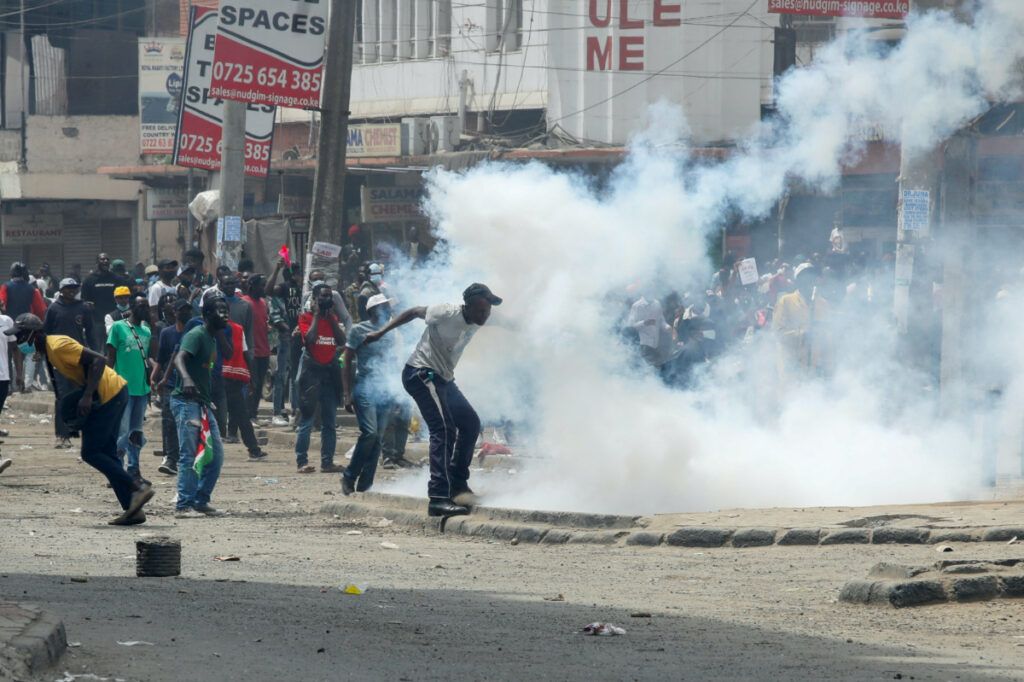
These “hired goons,” as they were described, engaged in looting, targeted property destruction, and instigated violence, effectively contaminating legitimate civic action with criminal activity.
This form of sabotage raises significant questions. Were these actors mobilized to discredit the protest movement? Were they exploiting unrest for political or financial gain? Either possibility points to a democracy in deep distress — where protest is no longer purely civic, but also dangerously manipulated.
As unrest grew, the government’s response turned increasingly authoritarian. Sixty-one people were arrested nationwide — most in Nairobi — as security agencies moved to preempt escalation.
Yet the most jarring state action was not physical, but informational. The Communications Authority of Kenya issued a directive to media houses — halt all live broadcasts of the protests.
This attempt to silence real-time coverage of civil unrest is more than a media restriction — it is a violation of the public’s right to know, to see, and to hold power accountable. The KNCHR strongly condemned the move, calling it a betrayal of constitutional principles and a step backward for Kenya’s democratic maturity.
The June 25 protests have illuminated the state of the nation. Kenya is not merely divided over policy — it is fractured over power, voice, and legitimacy. The suppression of protest through violence, arrest, and censorship does not erase the discontent. It only delays its return.
The presence of criminal elements, the death toll, the staggering number of injuries, and the clampdown on information together signal a political landscape drifting toward volatility.
The Kenya National Commission on Human Rights has vowed to continue monitoring the situation. But monitoring is no longer enough. The people have spoken with their feet and now with their blood. What remains to be seen is whether the government will respond with reform — or with further repression.
Closing Thought:
The fire lit on June 25 was not spontaneous — it was the result of smoldering frustrations that the state has long ignored. If the current leadership continues to douse protests with fear and silence, the next flare-up may be even more uncontrollable — and far more costly.






0 comments