
Your Read is on the Way
Every Story Matters
Every Story Matters
The Hydropower Boom in Africa: A Green Energy Revolution Africa is tapping into its immense hydropower potential, ushering in an era of renewable energy. With monumental projects like Ethiopia’s Grand Ethiopian Renaissance Dam (GERD) and the Inga Dams in the Democratic Republic of Congo, the continent is gearing up to address its energy demands sustainably while driving economic growth.
Northern Kenya is a region rich in resources, cultural diversity, and strategic trade potential, yet it remains underutilized in the national development agenda.

Can AI Help cure HIV AIDS in 2025

Why Ruiru is Almost Dominating Thika in 2025

Mathare Exposed! Discover Mathare-Nairobi through an immersive ground and aerial Tour- HD

Bullet Bras Evolution || Where did Bullet Bras go to?
In a sorrowful but defiant ceremony held in Kangema, Murang’a County, Kenyans gathered to bury Boniface Kariuki — a 22-year-old mask vendor whose life was abruptly cut short during a protest. The young man, known for his hard work and gentle spirit, became a national symbol of the many lives lost in recent demonstrations.
From the moment his coffin arrived, wrapped in the Kenyan flag, the air was thick with grief. Cries of mourning echoed across the hillside as his family, led by his inconsolable mother, received the body of a son taken far too soon. Her collapse beside the casket captured the depth of familial devastation that no words could describe.
The funeral was not only a moment of sorrow but also one of protest. His coffin was carried by peers through a sea of flags and raised fists. A chilling photograph of the moment he was fatally shot had been carefully placed atop the white coffin — a silent but piercing protest against brutality. It was a visual truth that no speech could contest.
Mourners, most of them young, danced in circles around the gravesite. It was not a celebration but an act of remembrance and resistance — a solemn performance of unity that declared, “We will not forget.”
Notably absent from the funeral were uniformed police officers. Their absence was intentional — perhaps an attempt to avoid inflaming already heightened emotions. However, the silence from state security forces only amplified the crowd’s anger. Riot units were reportedly on standby nearby, underscoring the tension surrounding the event.
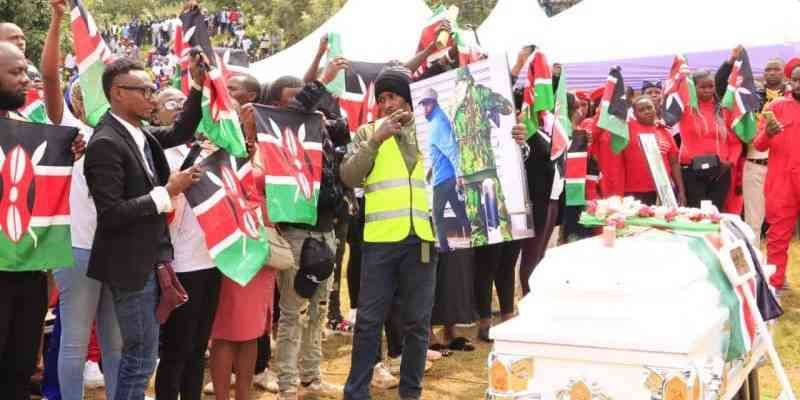
Local leaders who attended spoke strongly, condemning the senseless killings and vowing that this would not be the end of the conversation. Some openly called for accountability from those in power, vowing to push for investigations and reforms.
Several other grieving mothers stood alongside Kariuki’s family. They had also lost sons in the recent wave of protests. Their faces, lined with anguish, formed a haunting collective portrait of what has become a tragic pattern in the country: young lives being extinguished in moments of national unrest.
Their presence turned the funeral into a rallying cry for justice — a reminder that the pain was shared, and the wounds ran deep across many Kenyan households.
Boniface Kariuki was buried as a victim — not of random violence, but of a deeply fractured system that many say no longer protects its people. His grave may be a resting place, but for many in attendance, it marked the beginning of something far greater: a collective call for accountability, truth, and healing.
What was meant to be a quiet village burial became a powerful national moment. A life lost to a bullet became a voice for thousands. And from the tears shed at Kariuki’s final farewell, a movement strengthened — grounded in grief, but driven by resolve.




0 comments