
Your Read is on the Way
Every Story Matters
Every Story Matters
The Hydropower Boom in Africa: A Green Energy Revolution Africa is tapping into its immense hydropower potential, ushering in an era of renewable energy. With monumental projects like Ethiopia’s Grand Ethiopian Renaissance Dam (GERD) and the Inga Dams in the Democratic Republic of Congo, the continent is gearing up to address its energy demands sustainably while driving economic growth.
Northern Kenya is a region rich in resources, cultural diversity, and strategic trade potential, yet it remains underutilized in the national development agenda.

Can AI Help cure HIV AIDS in 2025

Why Ruiru is Almost Dominating Thika in 2025

Mathare Exposed! Discover Mathare-Nairobi through an immersive ground and aerial Tour- HD

Bullet Bras Evolution || Where did Bullet Bras go to?
What should have been a solemn remembrance of Kenya’s democratic turning point in 1990 turned instead into a day of coordinated suppression, fear, and violence. As the country marked Saba Saba on July 7, 2025, the Kenya National Commission on Human Rights (KNCHR) raised the alarm over severe and widespread violations of civil liberties. In a damning late-evening report, the Commission laid bare the cost of a government choosing force over dialogue.
By 6:30 p.m., KNCHR had verified the deaths of ten civilians, twenty-nine cases of serious injuries, two abductions, and thirty-seven arrests. These figures, drawn from at least seventeen counties, represent a national descent into the kind of brutality that Saba Saba originally rose to resist.
Across Nairobi and other major towns, key transport corridors were sealed off with police barricades. Movement became nearly impossible in places like Kerugoya, Kisumu, and Nakuru. Government workers were instructed to report for duty, but the streets were empty.
Businesses shuttered in fear of looting, with six counties confirming incidents of theft and property destruction. One shocking attack saw criminals torch the Kerugoya Central Constituency Development Fund (CDF) office, underscoring the breakdown of both order and accountability.
Public services faltered entirely. Schools closed their doors as parents kept children home. Hospitals were inaccessible, and some patients reportedly missed urgent care due to roadblocks. Air and rail transport stalled, leaving hundreds stranded. Kenya, on this day, stood still—not in silent reflection, but in panic and paralysis.
One of the gravest concerns raised by KNCHR was the total defiance of a standing court order requiring that officers deployed for protest policing wear uniforms and carry identification. Instead, dozens of hooded individuals—armed, unmarked, and moving in unregistered vehicles—were observed in Nairobi, Kajiado, and Nakuru. These were not anomalies. They were part of a coordinated pattern that now appears to extend beyond official forces.
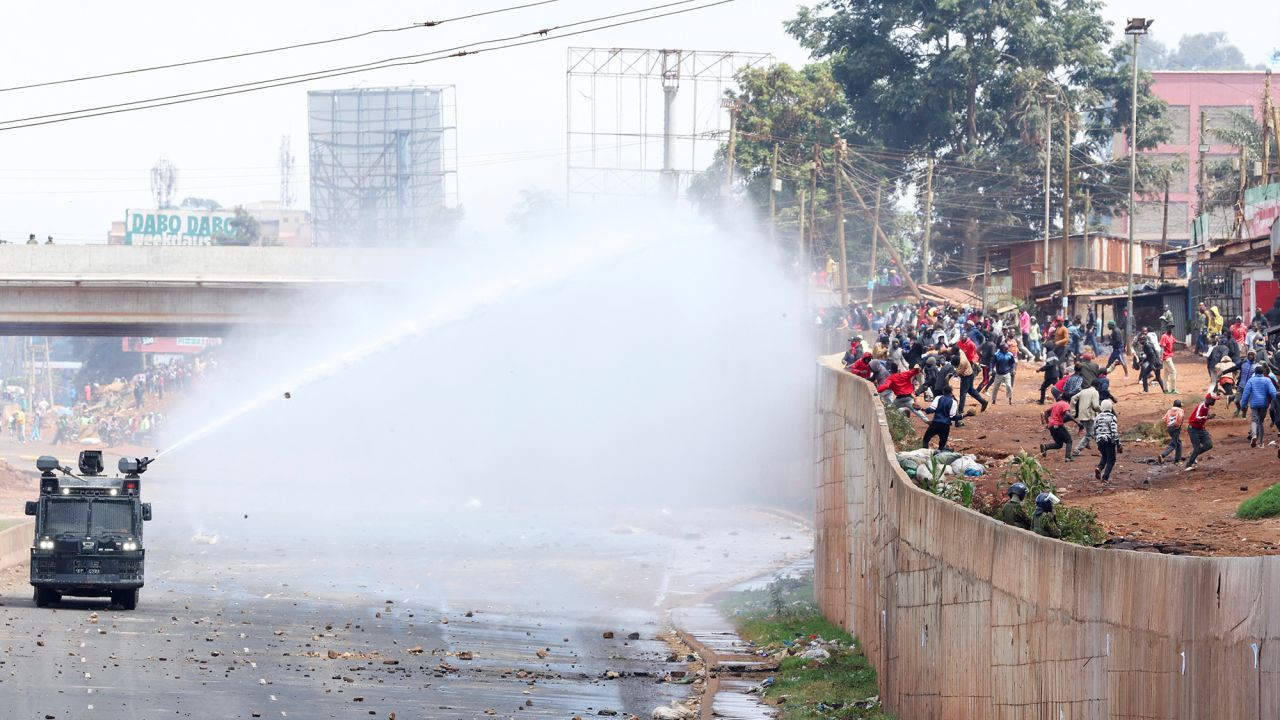
More disturbing still was the confirmed presence of armed civilian gangs operating in tandem with police. In Nairobi, Kiambu, Eldoret, and Kajiado, protestors and innocent bystanders were attacked by groups wielding machetes, clubs, and bows and arrows. The implication: a disturbing alliance between state security forces and criminal elements to subdue dissent by any means necessary.
Human rights groups were not spared. In a brazen assault, goons stormed the Kenya Human Rights Commission’s (KHRC) offices, beating staff, attacking civilians, and targeting journalists who had come to document the incident. Those journalists were not only assaulted but robbed, their tools of accountability—cameras, phones, recorders—stolen in a clear attempt to silence witnesses.
This attack, reportedly captured on CCTV, has prompted KNCHR to demand the immediate arrest and prosecution of all individuals involved. But whether these calls will be honored remains uncertain in a climate where rule of law has taken a backseat to state-backed thuggery.
Perhaps most worrying is the broader campaign unfolding quietly in the background: the targeting of human rights defenders. Over the past week alone, more than twenty individuals associated with civil society organizations have been arrested, beaten, or threatened. These are not criminals. These are lawyers, observers, volunteers—citizens fulfilling the very duties Saba Saba was meant to protect.
KNCHR warned that such persecution not only violates individual freedoms but sends a dangerous signal: that speaking out in Kenya is once again becoming a high-risk activity, punishable by violence, arrest, or worse.
Saba Saba was never about violence. It was about demanding dignity, voice, and representation through peaceful resistance. Yet in 2025, the very ideals it once defended have been trampled. The government has responded to civil unrest with terror tactics, using police and proxies to crush public morale and criminalize dissent.
The Kenya National Commission on Human Rights has drawn a line. It has named the abuses, counted the victims, and demanded accountability. Now, the test lies not just with law enforcement or government but with the public. Will Kenya stand idle as fear becomes the new normal? Or will this Saba Saba mark not just pain, but awakening?





0 comments