
Your Read is on the Way
Every Story Matters
Every Story Matters
The Hydropower Boom in Africa: A Green Energy Revolution Africa is tapping into its immense hydropower potential, ushering in an era of renewable energy. With monumental projects like Ethiopia’s Grand Ethiopian Renaissance Dam (GERD) and the Inga Dams in the Democratic Republic of Congo, the continent is gearing up to address its energy demands sustainably while driving economic growth.
Northern Kenya is a region rich in resources, cultural diversity, and strategic trade potential, yet it remains underutilized in the national development agenda.

Can AI Help cure HIV AIDS in 2025

Why Ruiru is Almost Dominating Thika in 2025

Mathare Exposed! Discover Mathare-Nairobi through an immersive ground and aerial Tour- HD

Bullet Bras Evolution || Where did Bullet Bras go to?
When President William Ruto stood before a crowd in Mukuru Kwa Njenga to hand over 1,080 newly constructed housing units, it wasn’t just another ribbon-cutting event. It was a deliberate move to reframe the narrative around his widely debated Affordable Housing agenda. What unfolded wasn’t merely administrative—it was personal, political, and symbolic.
For a president often criticized for failing to deliver tangible results amid economic hardship, this project offered something rare: visible, physical proof that his policies can manifest into concrete change. Ruto was exuberant, not just with joy, but with a sense of vindication. He sang, prayed, quoted scripture, and repeatedly asked the crowd whether critics were still justified in doubting him. It was as much a performance as it was policy.
Throughout his speech, Ruto made it clear that this milestone was about more than just shelter. It was a message to his critics—both within government and in the opposition—that his housing vision was not only real but functional. For months, the Affordable Housing initiative has been labeled impractical, elitist, or even corrupt.
By physically delivering keys to new homeowners, many of whom had been living in slums, Ruto took the opportunity to dismiss the skepticism. “They said I was lying. Today, I am here handing over homes. Is this not the truth?” he asked, looking to the crowd for confirmation. This wasn’t a defensive speech—it was an offensive strategy. He made it clear: the project will continue, and his critics would have to keep up.
The president also positioned the Mukuru Kwa Njenga housing development as a significant economic tool, not just a welfare project. According to Ruto, the initiative has already injected Ksh.11 billion into the construction sector and neighborhood infrastructure. When accounting for indirect economic activity, he estimated the total impact at Ksh.28 billion.
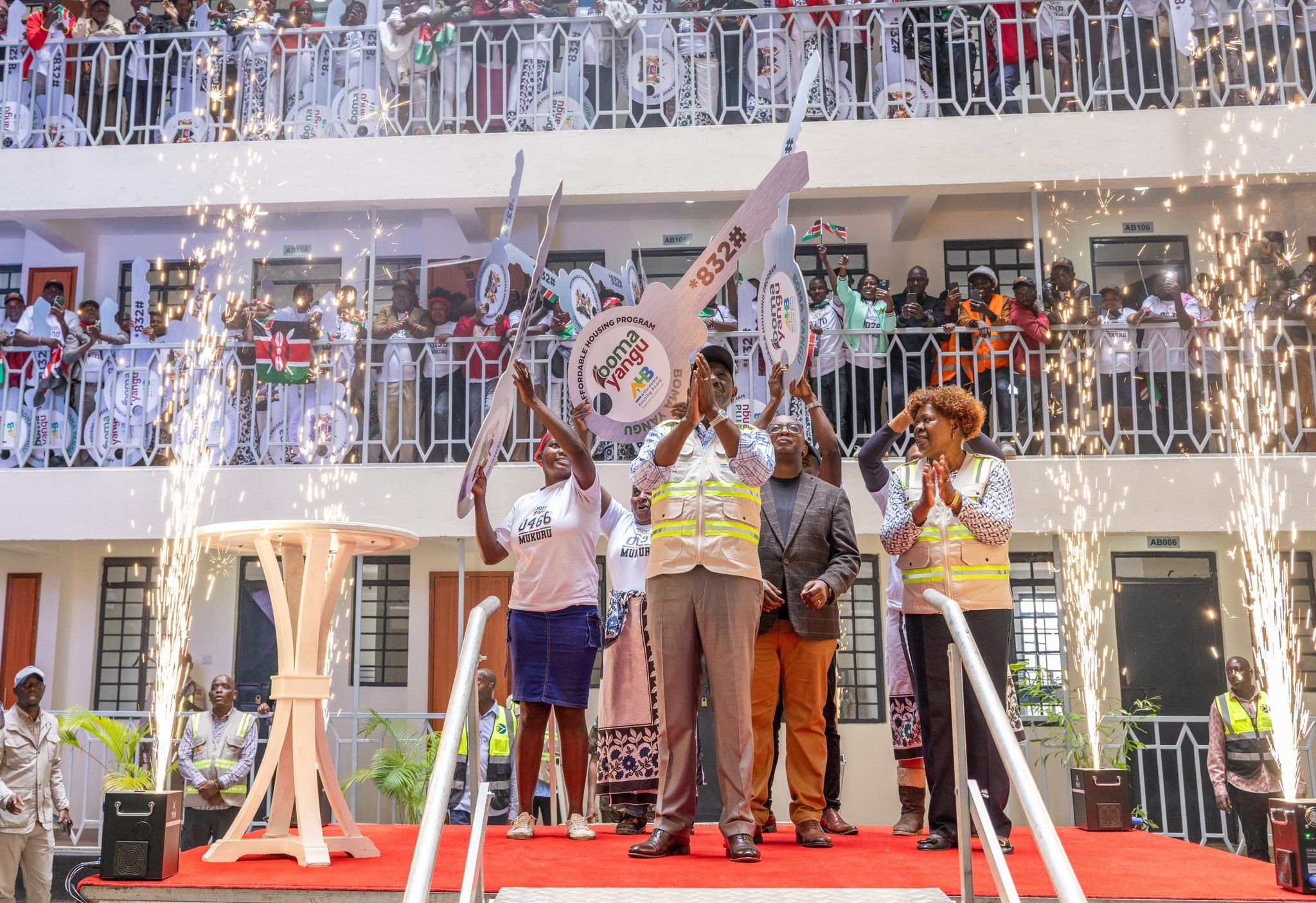
This, he emphasized, is how public investment should work—by creating jobs, enabling small businesses, and activating dormant urban economies. “We’re not just building homes,” Ruto said, “we’re creating ecosystems.” It’s a narrative that attempts to align his administration’s housing program with broader economic recovery and job creation goals.
The Mukuru Kwa Njenga site itself reflects a deeper vision for urban renewal. The development includes 3.2 kilometers of roads, nearly 10 kilometers of walkways and sewers, 14,000 square meters of parking, and dozens of key amenities: fire stations, health clinics, strip malls, daycare centers, and even a network of 32 transformer houses.
Ruto highlighted the inclusion of a five-million-litre underground water tank and a fire suppression system, framing it as not just development, but dignity—an upgrade in both living standards and safety. These aren’t just houses, the president stressed, but complete communities where schools, shops, salons, gyms, and small businesses can thrive. The message was clear: this is how a government should reimagine informal settlements.
This event, Ruto noted, is only the first of many. He promised that by August or September, another 5,000 housing units would be ready for handover. A second wave of 5,000 is slated for early next year, with the ultimate goal of delivering 13,000 homes in the Mukuru region alone. This phased rollout isn’t just logistical—it’s political. By spacing out handovers over the next year and beyond, the government ensures a steady stream of good press and community engagement. It’s a method that turns infrastructure into narrative fuel—each handover reinforcing the president’s agenda while undercutting critics in real-time.
Closing the event, Ruto called on more Kenyans to sign up for homes under the Affordable Housing Programme via the Boma Yangu platform. He positioned it as a transparent and fair system that would give ordinary citizens a shot at owning property—something that had previously felt out of reach for millions. In doing so, he cast the housing scheme not only as a physical transformation but as a social one, inviting the public to see homeownership as attainable, even in a strained economy. It was a moment where politics, policy, and performance merged—an attempt to build not just homes, but public trust.
Read this related article: Boma Yangu: How Kenya Is Turning Renters Into Homeowners




0 comments