
Your Read is on the Way
Every Story Matters
Every Story Matters
The Hydropower Boom in Africa: A Green Energy Revolution Africa is tapping into its immense hydropower potential, ushering in an era of renewable energy. With monumental projects like Ethiopia’s Grand Ethiopian Renaissance Dam (GERD) and the Inga Dams in the Democratic Republic of Congo, the continent is gearing up to address its energy demands sustainably while driving economic growth.
Northern Kenya is a region rich in resources, cultural diversity, and strategic trade potential, yet it remains underutilized in the national development agenda.

Can AI Help cure HIV AIDS in 2025

Why Ruiru is Almost Dominating Thika in 2025

Mathare Exposed! Discover Mathare-Nairobi through an immersive ground and aerial Tour- HD

Bullet Bras Evolution || Where did Bullet Bras go to?
Kenya’s war against illicit brews has been ongoing for decades — and yet, in slums, rural settlements, and even some urban corners, these deadly concoctions remain widely available. Cheap, fast to produce, and dangerously unregulated, illicit brews offer a bitter escape to the economically desperate while quietly claiming thousands of lives, leaving destruction in their wake.
Illicit brews refer to locally manufactured alcoholic beverages that are unregulated, unlicensed, and typically produced in unsanitary environments. Known by many names — chang’aa, kangara, busaa, muratina, or jet fuel — these drinks are often made from fermented maize, millet, or sorghum, and dangerously laced with substances like methanol, battery acid, formalin, or industrial spirits to increase potency.
The end result is a cheap high with unpredictable — and often lethal — consequences.
The demand for illicit brews is driven by a mix of poverty, addiction, joblessness, and lack of access to safer, regulated alternatives. In many marginalized counties, licensed alcohol is either too expensive or entirely unavailable. Unemployment among youth and a sense of hopelessness make illicit alcohol an attractive and quick escape.
For brewers, it’s a means of survival. With minimal capital, they can set up small production units hidden in slums, forests, or valleys. A few hours of fermentation and dilution, and the product is ready for sale at a fraction of the cost of factory liquor.
The consequences are often fatal. Methanol poisoning, liver failure, blindness, psychosis, and death are common outcomes. In some regions like Nakuru, Kisii, Nyeri, Embu, and Nairobi’s informal settlements, entire communities have been paralyzed by the ripple effect of addiction, health deterioration, broken families, and crime spikes linked to these brews.
The victims often include the poor, casual laborers, boda boda riders, and even school-going children lured by cheap prices.
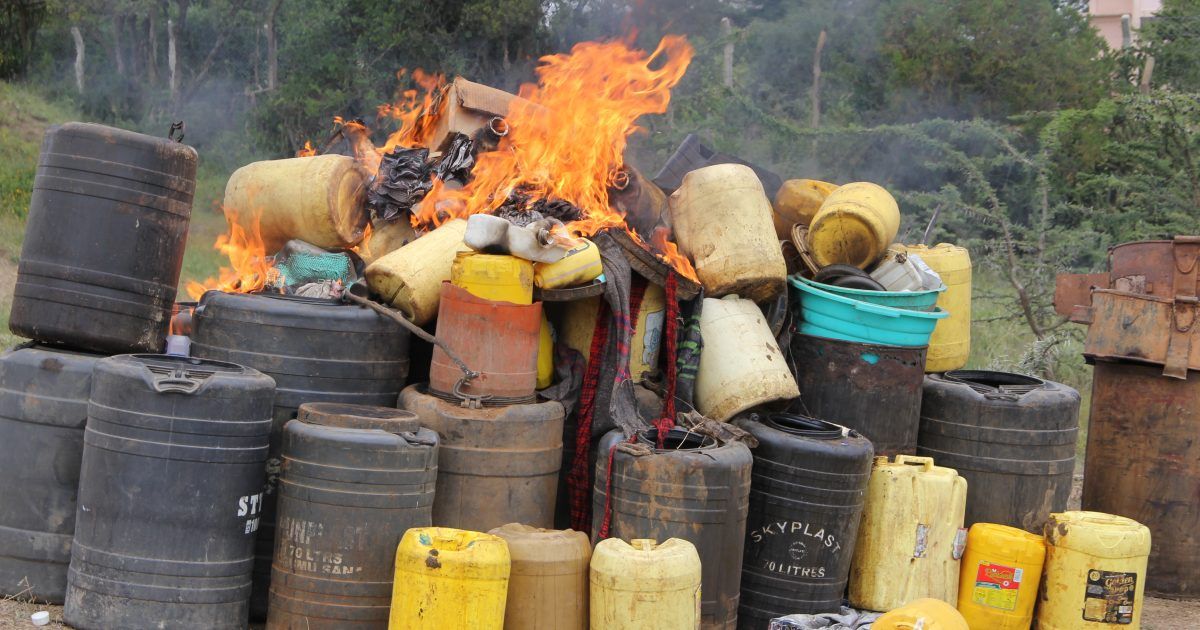
Over the years, the government has launched numerous raids, arrests, and public destruction of illicit alcohol. Notable crackdowns in Central Kenya and parts of Nairobi have yielded temporary results, with brewing dens being shut down and contraband alcohol seized.
Laws such as the Alcoholic Drinks Control Act and various County Liquor Licensing Boards have tried to regulate and license production. Still, corruption, political interference, and the resilience of underground networks mean these efforts often fail to achieve long-term impact.
Several underlying factors explain why illicit brews won’t go away easily:
-Weak enforcement: Police often lack resources or are compromised by bribes.
-Corruption: Local officials and politicians sometimes protect brewers for votes or kickbacks.
-Unemployment: With few economic alternatives, illicit brewing remains a vital income source.
-Cultural normalization: In some regions, homemade alcohol is a traditional norm, making crackdowns unpopular.
-Lack of rehab programs: Addiction is widespread, but affordable treatment is rare.
The solution cannot lie in police raids alone. To effectively tackle Kenya’s illicit brew crisis, a multidimensional approach is needed:
1.Community-led awareness campaigns about the dangers of toxic brews.
2.Investment in rural and informal economies to create alternative income streams.
3.Strengthening the legal alcohol industry to ensure safer, affordable alternatives.
4.Rehabilitation and mental health support for addicts.
5.Stronger punishment for corrupt officials and complicit police officers





0 comments