
Your Read is on the Way
Every Story Matters
Every Story Matters
The Hydropower Boom in Africa: A Green Energy Revolution Africa is tapping into its immense hydropower potential, ushering in an era of renewable energy. With monumental projects like Ethiopia’s Grand Ethiopian Renaissance Dam (GERD) and the Inga Dams in the Democratic Republic of Congo, the continent is gearing up to address its energy demands sustainably while driving economic growth.
Northern Kenya is a region rich in resources, cultural diversity, and strategic trade potential, yet it remains underutilized in the national development agenda.

Can AI Help cure HIV AIDS in 2025

Why Ruiru is Almost Dominating Thika in 2025

Mathare Exposed! Discover Mathare-Nairobi through an immersive ground and aerial Tour- HD

Bullet Bras Evolution || Where did Bullet Bras go to?
In a dramatic twist that has sent shockwaves across Kenya’s political landscape, Trans Nzoia Governor George Natembeya was arrested on the morning of May 19, 2025. The arrest came after a covert operation by the Ethics and Anti-Corruption Commission (EACC), which culminated in a dawn raid at his residence in Nairobi. Natembeya, once celebrated as a bold reformist and a hands-on administrator, was bundled into custody under a heavy security presence, igniting a media frenzy and political outcry.
The allegations against him are grave: misuse of public funds amounting to approximately Ksh1.4 billion, a sum allegedly siphoned from multiple flagship county projects. The arrest marks a stunning reversal of fortune for the former Rift Valley Regional Commissioner, who ascended to political prominence on an anti-corruption platform. Now, the same vice he vowed to fight has ensnared him in a scandal that threatens not only his political career but also the fragile trust between citizens and their devolved governments.
According to insiders close to the investigation, the financial trail that led to Natembeya’s arrest centers around three high-profile county projects: the stalled Kenyatta Stadium renovation, the ongoing construction of the Trans Nzoia county headquarters, and the Tom Mboya Level 5 Hospital expansion. Collectively, these projects were allocated significant funding, but a forensic audit allegedly revealed serious procurement anomalies, unexplained cost escalations, and shadowy payments to shell companies.

Investigators believe the funds were funneled through well-crafted tenders, awarded under opaque circumstances to firms with questionable credentials—some of which are said to have direct links to individuals in Natembeya’s inner circle. Whistleblowers within the county government claim that contractors were coerced into offering kickbacks in exchange for winning bids. These payments, it is alleged, were disguised as “consultancy fees” and routed through a maze of bank accounts controlled by proxies loyal to the governor.
As Natembeya was hauled in for questioning, his legal team moved swiftly, accusing the EACC of violating due process. His lawyers argued that they were denied immediate access to their client and claimed the arrest was politically motivated, orchestrated by rivals eager to neutralize him ahead of the 2027 general elections. Despite these claims, the EACC maintained that it followed proper legal channels and acted on “credible intelligence” and months of surveillance.
Observers believe that this case may open a legal battle that will grip the nation for months. The governor’s defense is expected to challenge the admissibility of the procurement audit, question the chain of custody for financial documents, and argue that any mismanagement was bureaucratic rather than criminal. Meanwhile, prosecutors are reportedly preparing a battery of charges, including abuse of office, conspiracy to defraud the public, and obstruction of justice.
The arrest reverberated far beyond Nairobi. In Kitale, the political heart of Trans Nzoia County, hundreds of Natembeya’s supporters took to the streets in protest. Waving placards and chanting slogans, they condemned the arrest as an attack on their democratic will and accused the state of targeting their elected leader unfairly. The demonstrations quickly turned chaotic, with police deploying tear gas to disperse crowds and arresting several protestors for alleged incitement.
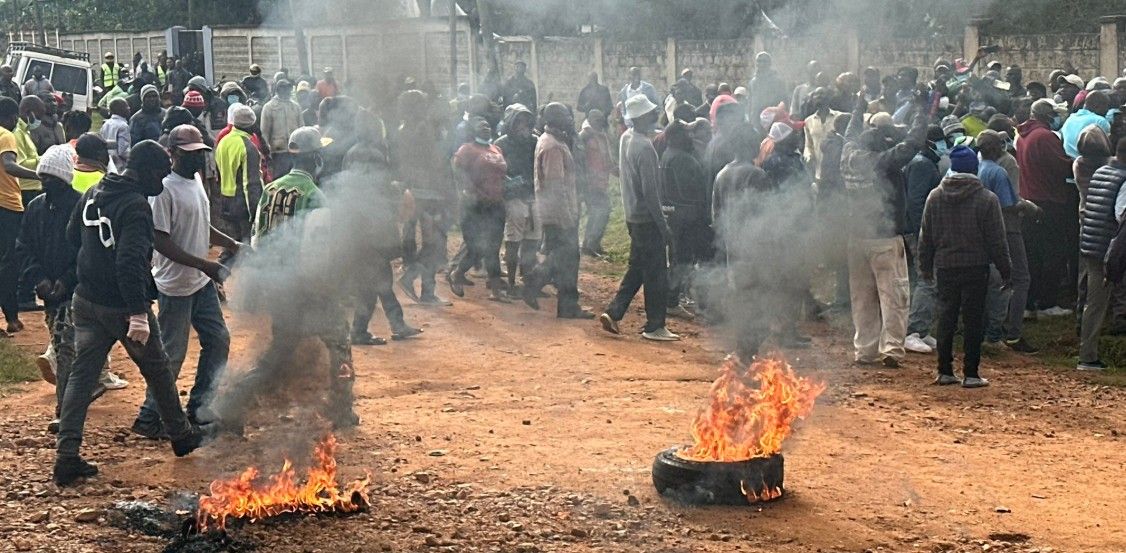
This unrest underscores the deep political polarization in the region. While some residents see the arrest as a long-overdue step toward accountability, others view it as a power grab engineered by political elites in Nairobi. Local politicians aligned with Natembeya have vowed to mobilize mass action unless he is released unconditionally, raising fears of sustained unrest and ethnic tensions in the cosmopolitan county.
As the dust begins to settle, the implications of Natembeya’s arrest are far-reaching. In the immediate term, the County Executive Committee is expected to operate under a cloud of uncertainty, with questions arising about the continuity of county programs and service delivery. Political analysts suggest that should Natembeya be charged and suspended from office, a fierce succession battle will likely ensue, further destabilizing the region.
At a national level, this arrest has reignited debate around the effectiveness of Kenya’s anti-corruption efforts. While some hail it as a sign of renewed commitment to justice, others caution that unless similar action is taken against powerful figures across the political divide, it will be perceived as selective justice. The EACC, meanwhile, is said to be expanding its probe into other county officials and contractors, hinting at an even broader crackdown in the weeks to come.






0 comments