
Your Read is on the Way
Every Story Matters
Every Story Matters
The Hydropower Boom in Africa: A Green Energy Revolution Africa is tapping into its immense hydropower potential, ushering in an era of renewable energy. With monumental projects like Ethiopia’s Grand Ethiopian Renaissance Dam (GERD) and the Inga Dams in the Democratic Republic of Congo, the continent is gearing up to address its energy demands sustainably while driving economic growth.
Northern Kenya is a region rich in resources, cultural diversity, and strategic trade potential, yet it remains underutilized in the national development agenda.

Can AI Help cure HIV AIDS in 2025

Why Ruiru is Almost Dominating Thika in 2025

Mathare Exposed! Discover Mathare-Nairobi through an immersive ground and aerial Tour- HD

Bullet Bras Evolution || Where did Bullet Bras go to?
President William Ruto has come out firmly to defend his administration’s ambitious campaign promises, brushing off criticism that his government bit off more than it could chew. Speaking during the Third National Executive Retreat in Kajiado County, the Head of State reaffirmed that the commitments laid out in his Bottom-Up Economic Transformation Agenda were not only realistic but achievable. He reiterated that there was no intention to revise or scale back these promises, despite the steep challenges his administration faces.
Ruto acknowledged that his government is navigating a complex path filled with tough choices, but insisted that the time to act is now. According to him, some advisers had cautioned against tackling controversial or difficult issues so early into his term. They had suggested holding off until a potential second term. The president, however, dismissed this notion, declaring that his focus lies not on future elections but on present-day transformation.
In a calculated rebuttal to claims of overpromising, Ruto maintained that every item listed in his administration's manifesto is practical and within reach. He argued that all the pledges were designed with feasibility in mind and backed by concrete policy frameworks. According to the president, critics underestimate the depth of planning and documentation that went into forming his campaign blueprint.
He emphasized that what others call “overpromising” is in fact strategic ambition, built to overhaul Kenya’s economic foundations.
To demonstrate his administration’s commitment, Ruto cited several ongoing reforms, including the intensification of affordable housing and the overhaul of the country’s health sector. He was particularly adamant that his government would not shy away from the difficult work required to elevate Kenya from economic stagnation.
On housing, President Ruto addressed public concerns regarding allocation fairness and affordability. While inspecting the progress of the Kibera Soweto East Zone B Affordable Housing Project, he reassured Kenyans that allocation would not be influenced by ethnicity or political affiliation. He pledged a transparent distribution system with local residents being prioritized. This statement came amid rising concerns over the controversial housing levy, one of the more contentious components of his economic agenda.
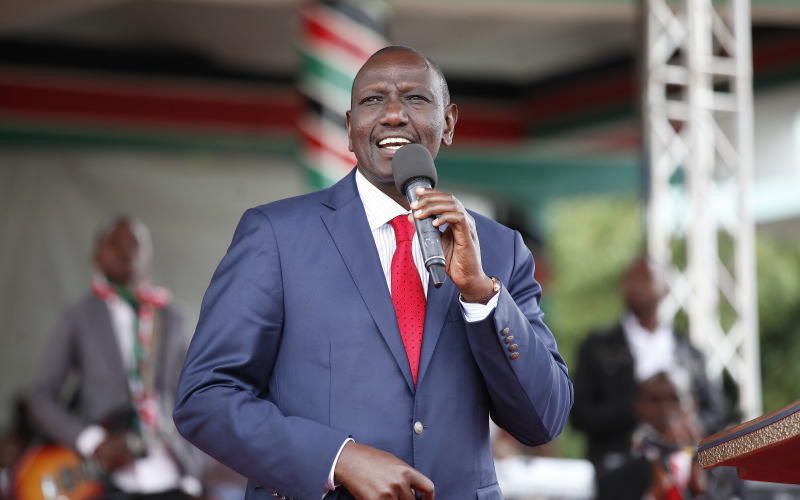
Despite the criticism, Ruto argued that the housing project was already creating jobs and reviving dormant construction industries. He positioned affordable housing as both a social good and an economic stimulant—aimed at addressing Kenya’s urban housing crisis while injecting liquidity into local economies.
Ruto also highlighted the strides made in the healthcare sector, particularly the transition from the National Health Insurance Fund (NHIF) to the revamped Taifa Care system under the Social Health Authority (SHA). He shared that over 23 million Kenyans have already registered for the new program, with daily registration numbers continuing to climb. According to the president, this demonstrates growing public trust in the system.
He praised Taifa Care for its broader inclusivity and accessibility, claiming that it addresses the systemic exclusions that plagued the NHIF, which primarily catered to salaried workers. Under the new scheme, every registered citizen becomes eligible for health services, ensuring more equitable access to care across all social classes.
President Ruto used the occasion to reaffirm his commitment to reform, not reactionary governance. He criticized any attempts to use civil unrest as a tool for political change, stating uneequivocally that the government would not be swayed by threats or street pressure. His remarks seemed particularly aimed at critics and activists preparing for the upcoming June 25 protests, largely driven by younger Kenyans demanding better governance.
Rather than scale down his agenda, Ruto emphasized that transformation requires not just vision, but the courage to face resistance. He underlined that the journey to a new Kenya won’t be smooth, but the foundation must be laid now.
In sum, President William Ruto made it clear that he does not intend to shift goalposts. He is prepared to endure criticism and political pressure if it means laying the groundwork for Kenya’s transformation. Whether through expanded housing programs, the overhauled healthcare system, or bold economic reforms, Ruto is banking on delivery—not rhetoric—to define his legacy.





0 comments