
Your Read is on the Way
Every Story Matters
Every Story Matters
The Hydropower Boom in Africa: A Green Energy Revolution Africa is tapping into its immense hydropower potential, ushering in an era of renewable energy. With monumental projects like Ethiopia’s Grand Ethiopian Renaissance Dam (GERD) and the Inga Dams in the Democratic Republic of Congo, the continent is gearing up to address its energy demands sustainably while driving economic growth.
Northern Kenya is a region rich in resources, cultural diversity, and strategic trade potential, yet it remains underutilized in the national development agenda.

Can AI Help cure HIV AIDS in 2025

Why Ruiru is Almost Dominating Thika in 2025

Mathare Exposed! Discover Mathare-Nairobi through an immersive ground and aerial Tour- HD

Bullet Bras Evolution || Where did Bullet Bras go to?
In a busy, politically charged neighborhood of Kariobangi, a conspicuous billboard appeared seemingly overnight, loudly celebrating Deputy President Rigathi Gachagua’s political accomplishments and leadership. This billboard wasn’t just any routine advertisement; it was a bold public statement meant to solidify his presence and influence within the community. The installation was intended to symbolize a collective cheer for Gachagua, signaling a show of strength and unity from his supporters at a critical moment in Kenya’s political calendar.
However, what was supposed to be a lasting emblem of victory and admiration ended up being a fleeting spectacle. Mere hours after it was unveiled, the billboard was violently ripped down, shredded, and carted away in a manner that left locals puzzled and stirred intense speculation. The swift destruction transformed the billboard from a symbol of celebration into a flashpoint of controversy, prompting widespread questions about what motivated such a rapid and forceful response.
The billboard was designed with precision to convey a triumphant message that went beyond congratulations. With its striking colors and bold lettering, it emphasized themes like freedom, leadership, and national progress — all attributes carefully associated with Gachagua’s political brand. For many residents, the billboard initially seemed to represent a hopeful vision, a rallying point for those who believed in his promise of better governance and social advancement. Yet, billboards in political contexts are rarely neutral. They function as powerful tools in the public arena, projecting not only support but also challenging opposing narratives.
In Kariobangi, an area with a rich tapestry of diverse political loyalties, such a public declaration was bound to stir strong emotions. While some saw the billboard as a sign of strength and optimism, others could interpret it as an intrusive reminder of political divides or an unwelcome display of propaganda that seemed to overshadow the community’s varied voices. The billboard's presence in the heart of Kariobangi was not just a passive decoration but an active participant in the ongoing discourse surrounding power, identity, and influence.
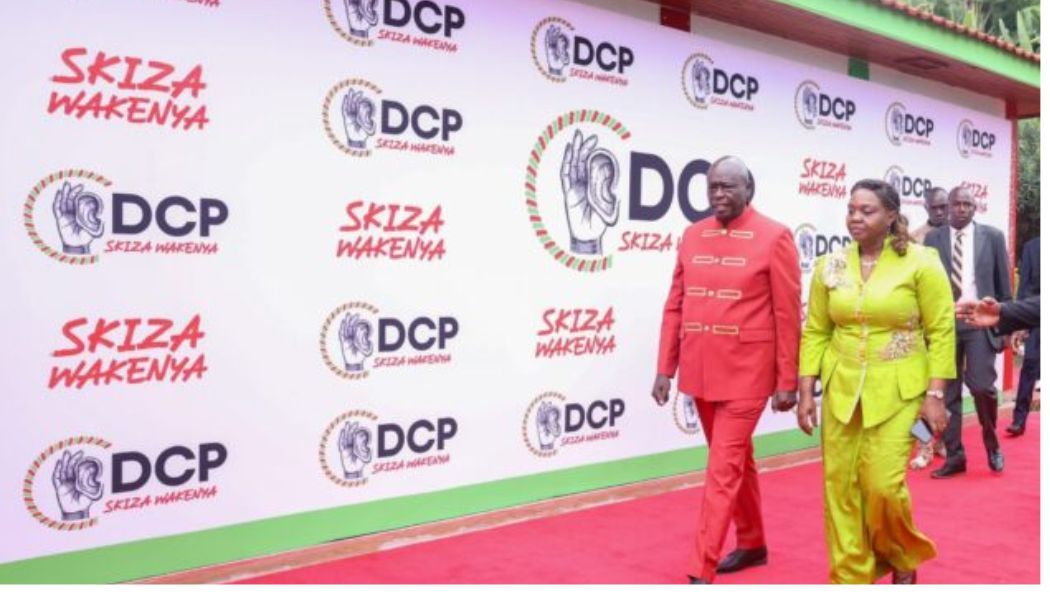
The billboard’s abrupt removal, within just a few hours of its debut, speaks volumes despite the lack of an official explanation. The act appeared highly coordinated, suggesting the involvement of individuals or groups with a clear agenda. Political rivalry is one of the most plausible explanations. In a nation known for its intense electoral battles and shifting alliances, opponents may have viewed the billboard as a provocation — a symbolic claim over territory that they considered contested or hostile.
Kariobangi itself is a melting pot of political affiliations, and the billboard might have been seen as a challenge to the delicate balance of power there. Alternatively, the rapid dismantling could signal strong local dissent. Public opinion is rarely monolithic, and some residents might have felt that the billboard’s message did not represent their views or interests. For them, tearing it down might have been an act of reclaiming public space, an expression of frustration with what they perceive as divisive political propaganda.
Beyond politics, the possibility of influence from powerful local figures cannot be ignored. In communities where informal power brokers hold sway, certain messages or symbols may be suppressed quietly but decisively to maintain control or prevent the empowerment of rivals. The removal might thus be part of a broader, less visible contest for influence.
What adds to the mystery is the apparent absence of any official response or investigation into the billboard’s destruction. Whether local police or municipal officials were involved, or simply turned a blind eye, remains unclear. The silence is notable in itself — it could reflect a reluctance by authorities to become embroiled in politically sensitive disputes that might inflame tensions. Alternatively, it might suggest tacit approval of the removal, signaling that certain political expressions are unwelcome or unacceptable in specific areas.
The lack of a formal statement or enforcement action raises troubling questions about the rule of law and freedom of expression in politically volatile environments. If political messages can be forcibly removed without consequence, the boundaries of acceptable discourse may shrink, chilling public participation and deepening divisions. The role and stance of law enforcement in this incident could therefore be as revealing as the act of tearing down the billboard itself, highlighting challenges in balancing political freedoms with social stability.
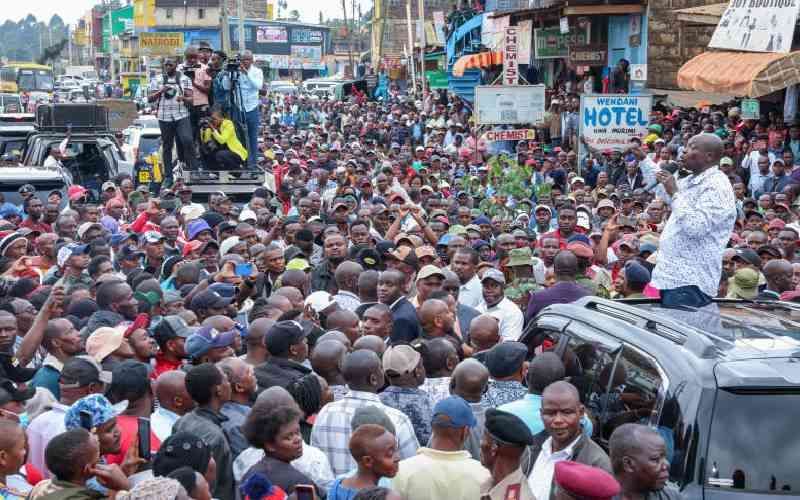
This dramatic episode is more than a local kerfuffle — it reflects the fragile and often contested nature of political expression in Kenya’s public spaces today. Billboards, murals, and posters have long been tools for citizens and politicians alike to communicate support, critique, or vision. Yet, when these symbols become targets of destruction, it exposes a deeper tension between free expression and political control.
The tearing down of the Rigathi Gachagua billboard underscores how vulnerable such public statements are to suppression, especially in areas marked by political polarization. It highlights the fine line between celebrating leadership and provoking backlash, and raises broader questions about how inclusive and tolerant political dialogue truly is. In this light, Kariobangi’s torn billboard becomes a microcosm of national dynamics — a battleground where narratives are contested, and where the space for open, respectful political conversation is precarious and often contested.
Looking forward, the incident opens several unresolved questions. Will supporters of the Deputy President respond by erecting a replacement billboard, perhaps even more boldly? Will Rigathi Gachagua or his political camp address the incident publicly, framing it as an attack on free expression or a symptom of political hostility? Moreover, will local authorities feel compelled to investigate and possibly prevent similar acts in the future, or will the episode be left to simmer quietly beneath the surface?
Beyond the immediate responses, this event forces a broader reflection on how political symbols are received, contested, and protected. It also challenges communities to confront the state of their political discourse and to consider how to foster an environment where differing views can coexist without fear of suppression. Ultimately, the torn billboard is not just about one man or one neighborhood — it’s a mirror reflecting the ongoing struggle over power, voice, and respect in Kenya’s democracy.





1 comment
guest
11mo ago
Haha