
Your Read is on the Way
Every Story Matters
Every Story Matters
The Hydropower Boom in Africa: A Green Energy Revolution Africa is tapping into its immense hydropower potential, ushering in an era of renewable energy. With monumental projects like Ethiopia’s Grand Ethiopian Renaissance Dam (GERD) and the Inga Dams in the Democratic Republic of Congo, the continent is gearing up to address its energy demands sustainably while driving economic growth.
Northern Kenya is a region rich in resources, cultural diversity, and strategic trade potential, yet it remains underutilized in the national development agenda.

Can AI Help cure HIV AIDS in 2025

Why Ruiru is Almost Dominating Thika in 2025

Mathare Exposed! Discover Mathare-Nairobi through an immersive ground and aerial Tour- HD

Bullet Bras Evolution || Where did Bullet Bras go to?
On Thursday, a grim episode unfolded at a crowded market near a central urban junction, where armed security officers were engaged in efforts to contain widespread looting. Their presence, intended to enforce a fragile semblance of order in an increasingly lawless environment, was abruptly interrupted by a deadly aerial strike. The attack resulted in the deaths of several officers and civilians, marking yet another escalation in the ongoing breakdown of governance and public safety.
The assault targeted a force reportedly tasked with protecting food vendors and deterring violent theft. This force, whose authority has been severely undermined in recent months by repeated military strikes, has increasingly struggled to maintain law and order. The loss of personnel not only dealt a symbolic blow to the rule of law, but also practically dismantled efforts to stabilize conditions on the ground. Once again, civilians found themselves trapped between the competing realities of militarized conflict and humanitarian collapse.
The region's internal security apparatus, once central to managing public services and crisis response, has effectively been neutralized. With senior command structures decimated and operational capacity crippled, the result has been a surge in lawlessness. Looting of food supplies, theft from warehouses, and violent confrontations have become disturbingly routine.
What remains of the security forces is now heavily reliant on community networks and volunteer coordination—structures inadequate to manage large-scale humanitarian emergencies. As food becomes scarce and distribution irregular, tensions in overcrowded neighborhoods are growing more volatile by the day. The absence of a trusted, functioning civic body has led to an anarchic vacuum in which self-preservation eclipses communal solidarity.
Amid this civil deterioration, the rollout of a new food distribution system has introduced additional complications. Managed by a private foundation and protected by foreign security contractors, the system is designed to bypass international humanitarian agencies and deliver food in areas controlled by military forces. While it has achieved logistical efficiency in certain areas, it has also attracted intense criticism for its structural inequity and exclusionary nature.
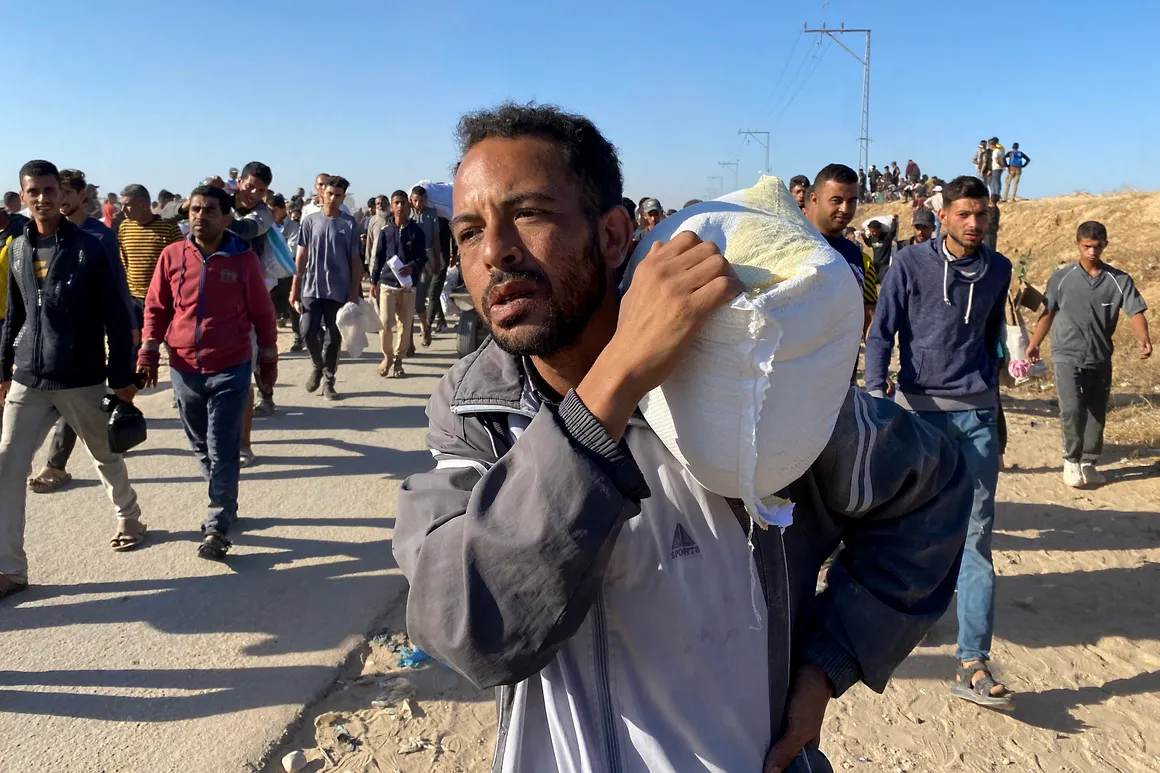
On the same Thursday, thousands of civilians arrived at one such distribution site, some having traveled great distances. For a fleeting moment, distribution appeared orderly—coordinated through loudspeaker instructions and surveillance drones hovering above. However, it quickly descended into chaos. Barriers were breached, and crowds surged forward, desperate to secure anything edible. Young men dominated the scramble, carrying sacks of flour and canned goods as others—especially the elderly, disabled, and women—were pushed aside or left stranded.
Many left with nothing. One elderly man, overcome with despair, described how he would return to his children with "dirt to eat." His statement, though metaphorical, encapsulates the hopelessness of a system that cannot protect its most vulnerable.
Proponents of the new aid mechanism argue that it prevents diversion of supplies by armed groups. Yet critics warn that the model, in its current form, not only lacks transparency but also effectively institutionalizes scarcity. By decoupling aid from established humanitarian oversight, and placing it under military and private control, it transforms food into a tool of strategic leverage rather than a universal human right.
Moreover, by reducing aid access to physical strength or proximity to power, the model punishes the weak and rewards the forceful. There is no accountability in such a framework—only survival of the fittest, a dystopian inversion of humanitarian principles. The result is not just hunger but humiliation, disempowerment, and the gradual erosion of human dignity.
The events of Thursday are not merely logistical failures; they are evidence of a larger collapse—of governance, of ethics, and of collective responsibility. This is not just a region in need of food. It is a population under siege from within and without, caught in a spiraling emergency with no clear path to recovery.
Without a renewed commitment to civilian protection, inclusive aid delivery, and international legal standards, the situation will only deteriorate. The global community must move beyond reactive responses and address the structural violence underpinning this humanitarian disaster.
In the end, the images from that day—of empty hands, broken systems, and unseen suffering—demand more than pity. They demand justice.





0 comments