
Your Read is on the Way
Every Story Matters
Every Story Matters
The Hydropower Boom in Africa: A Green Energy Revolution Africa is tapping into its immense hydropower potential, ushering in an era of renewable energy. With monumental projects like Ethiopia’s Grand Ethiopian Renaissance Dam (GERD) and the Inga Dams in the Democratic Republic of Congo, the continent is gearing up to address its energy demands sustainably while driving economic growth.
Northern Kenya is a region rich in resources, cultural diversity, and strategic trade potential, yet it remains underutilized in the national development agenda.

Can AI Help cure HIV AIDS in 2025

Why Ruiru is Almost Dominating Thika in 2025

Mathare Exposed! Discover Mathare-Nairobi through an immersive ground and aerial Tour- HD

Bullet Bras Evolution || Where did Bullet Bras go to?
President Donald Trump stepped off Air Force One into the blazing Riyadh heat and onto a lavender carpet—a subtle but royal touch by Saudi hosts. This wasn’t just another diplomatic stop; it was the opening act of a meticulously choreographed power play. Trump, known for his love of spectacle and deal-making, was met with both. Crown Prince Mohammed bin Salman greeted him personally, symbolizing how central this meeting was to Saudi Arabia’s regional strategy.
Saudi fighter jets accompanied Trump’s arrival, and the streets were lined with American and Saudi flags. It was more than ceremonial—it was a signal: the Kingdom was rolling out not just the carpet, but a proposition. This visit wasn’t about pageantry alone. It was business, defense, and dominance.
At the core of this visit lies a staggering proposal—$600 billion in Saudi investment into the U.S. economy over the next four years. While details remain largely under wraps, the targeted sectors include defense, artificial intelligence, energy infrastructure, and even space technology. For Trump, it’s a golden pitch: American jobs, revitalized industries, and strategic tech advancement—all without raising taxes or waiting on Congress.
For Mohammed bin Salman, it’s a calculated step in transforming Saudi Arabia’s oil-reliant economy. The Crown Prince’s Vision 2030 reforms are bold, expensive, and time-sensitive. What better partner than the U.S., especially under a president willing to swap hard criticism for hard cash?
Conspicuously missing from Trump’s itinerary is Israel—a glaring omission considering the country's centrality in most U.S.-Middle East strategies. With ongoing friction between Washington and Prime Minister Netanyahu, particularly over Gaza and Iran policy, Trump is signaling a shift. The new focus? Gulf states with deep pockets and mutual enemies.
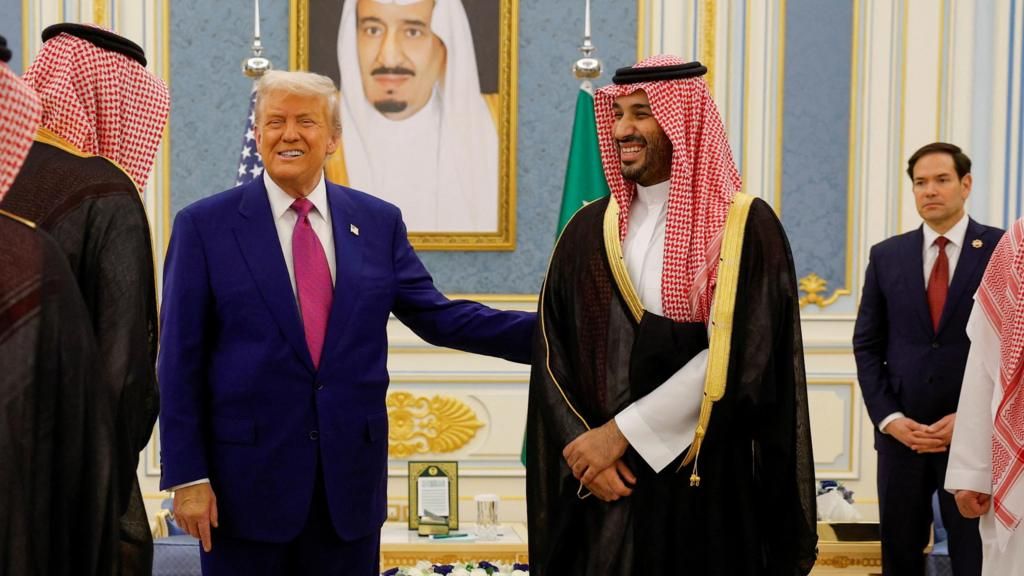
Discussions behind closed doors reportedly tackled Iran’s nuclear ambitions, escalating tensions in the Red Sea, and the aftermath of the Gaza war. With Syria’s regime collapse creating new power vacuums, Saudi Arabia is eager to redefine the regional balance—and Trump seems willing to help.
Saudi Arabia has agreed, informally, to boost oil production as a gesture to help stabilize global markets and support the U.S. economy. But this is no act of generosity. The kingdom is playing a delicate balancing act between global energy supply and its own fiscal health.
By cooperating with Trump, MBS ensures he has a powerful ally if tensions with Iran spike again. At the same time, higher oil exports give the U.S. a short-term inflation breather—a win Trump will likely brand as “economic diplomacy in action.”
This trip is about more than investments and defense contracts. It’s about cementing Trump’s role as a power broker in the Middle East during his second term. While the West debates human rights and democracy, Trump is leaning into a more transactional model: stability through strength, partnerships through profit.
In return, Saudi Arabia gets access to cutting-edge technology, military equipment, and the prestige of being Washington’s go-to partner in a region full of shifting allegiances. For both men, this isn’t just strategy—it’s legacy.
Trump's tour continues with stops in Qatar and the UAE, where similar themes are expected: economic deals, defense alignments, and digital partnerships. Yet it’s clear that Riyadh was the headline act. The ripple effects of this visit will be felt not only in the Pentagon and Silicon Valley, but across the sands of the Middle East.
This isn’t diplomacy as usual—it’s diplomacy as business, and Trump is back in the boardroom.




0 comments