
Your Read is on the Way
Every Story Matters
Every Story Matters
The Hydropower Boom in Africa: A Green Energy Revolution Africa is tapping into its immense hydropower potential, ushering in an era of renewable energy. With monumental projects like Ethiopia’s Grand Ethiopian Renaissance Dam (GERD) and the Inga Dams in the Democratic Republic of Congo, the continent is gearing up to address its energy demands sustainably while driving economic growth.
Northern Kenya is a region rich in resources, cultural diversity, and strategic trade potential, yet it remains underutilized in the national development agenda.

Can AI Help cure HIV AIDS in 2025

Why Ruiru is Almost Dominating Thika in 2025

Mathare Exposed! Discover Mathare-Nairobi through an immersive ground and aerial Tour- HD

Bullet Bras Evolution || Where did Bullet Bras go to?
The Treaty That Locked Nuclear Weapons Out of Africa
Across the globe, nuclear weapons are viewed as the ultimate strategic deterrent. Countries possessing them often wield enormous geopolitical influence. Yet Africa deliberately chose a different direction, embedding its stance into international law through the African Nuclear-Weapon-Free Zone Treaty, commonly known as the Pelindaba Treaty.
Related ReadReads: Trump Orders Devastating U.S. Airstrikes on Iran’s Nuclear Strongholds The Battle Over Iran’s Nuclear Program: Diplomacy, Espionage, and Military Threats |
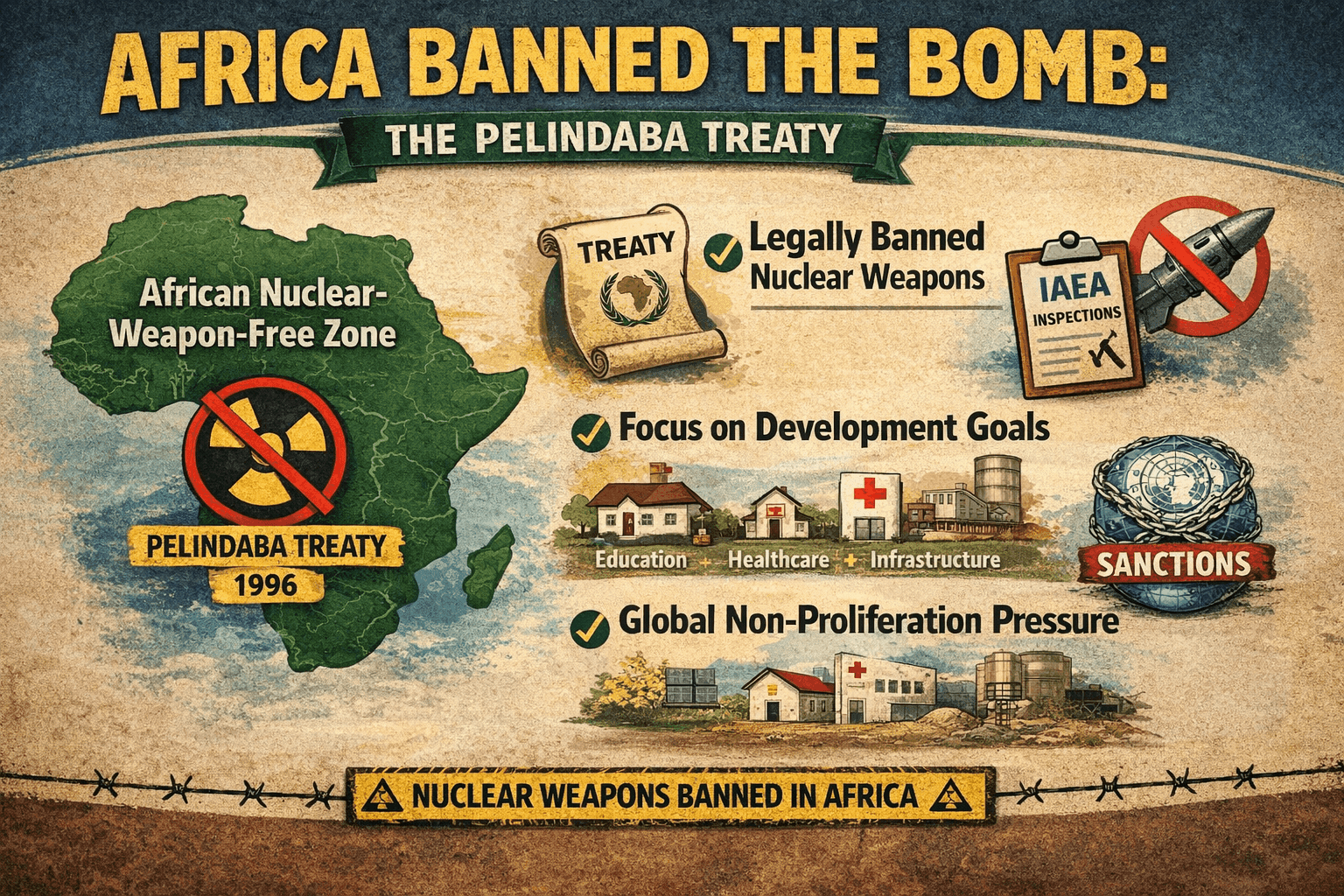
Signed in 1996 in Cairo, the Pelindaba Treaty formally committed African nations to prohibit the development, acquisition, testing, and possession of nuclear weapons anywhere on the continent. It also bans the dumping of radioactive waste within African territories and restricts the stationing of nuclear explosive devices in member states.
The agreement transformed Africa into one of the world’s largest nuclear-weapon-free regions. Instead of joining the global race for atomic arms, African leaders collectively decided that the continent’s long-term security would be better served through cooperation, diplomacy, and peaceful technological development.
Why the Agreement Was Named Pelindaba
The name “Pelindaba” carries symbolic weight. It was taken from the location of Pelindaba Nuclear Research Centre, a major nuclear facility outside Pretoria.
Ironically, that same facility had once been associated with nuclear weapons development during the Cold War era. Naming the treaty after Pelindaba signaled a dramatic shift: the continent was turning a site linked to nuclear arms into a symbol of nuclear restraint.
The message was unmistakable—Africa would not pursue atomic weapons as a path to power.
A Continent-Wide Commitment to Nuclear Restraint
The Pelindaba Treaty was negotiated under the umbrella of the African Union, which sought to establish Africa as a nuclear-weapon-free zone similar to agreements already in place in Latin America and the South Pacific.
Under the treaty, member states pledged to:
To enforce these commitments, African countries work closely with international monitoring institutions like the International Atomic Energy Agency, which oversees nuclear safeguards and inspections worldwide.
This framework ensures that nuclear materials in Africa remain dedicated to civilian purposes rather than military programs.
South Africa’s Unique Nuclear History
Before the Pelindaba Treaty came into force, one African nation had already ventured into nuclear weapons development. During the final decades of apartheid, South Africa secretly constructed six nuclear warheads.
However, in one of the most unusual decisions in nuclear history, the government dismantled the entire arsenal in the early 1990s before transitioning to democratic rule. The move paved the way for the country to join the Treaty on the Non-Proliferation of Nuclear Weapons and later champion the Pelindaba Treaty itself.
When Nelson Mandela assumed leadership of the country, South Africa became a vocal supporter of global nuclear disarmament.
This transformation—from nuclear weapons developer to advocate of nuclear prohibition—helped strengthen Africa’s collective stance against atomic arms.
Why African Nations Accepted the Ban
The Pelindaba Treaty was not simply symbolic. It reflected deeper realities shaping the continent’s priorities.
Developing nuclear weapons requires vast financial resources, advanced scientific infrastructure, and long-term strategic investment. For many African countries, national budgets are directed toward economic development, healthcare systems, infrastructure expansion, and education.
There is also the strategic calculation that nuclear weapons offer little advantage in the types of conflicts African nations typically face. Security threats across the continent are often internal or regional rather than large-scale wars between rival nuclear powers.
The treaty therefore codified a reality that many governments already recognized: nuclear weapons would be costly, politically risky, and strategically unnecessary.
Could Africa Ever Reverse Course?
Technically, some African nations possess the raw materials required for nuclear programs. Countries including Namibia, Niger, and South Africa hold significant uranium deposits.
But withdrawing from the Pelindaba Treaty would carry major diplomatic consequences. Any state attempting to develop nuclear weapons would face intense international scrutiny, sanctions, and potential isolation.
As a result, the treaty continues to stand as one of the most significant non-proliferation commitments in the developing world.
Africa’s Security Philosophy
More than just a legal document, the Pelindaba Treaty represents a strategic philosophy embraced across the continent. African leaders opted for regional stability and cooperation rather than entering the dangerous global competition for nuclear supremacy.
In a world where nuclear weapons still dominate geopolitical power structures, Africa’s position remains unusual: a vast continent rich in uranium but committed to never turning that resource into instruments of mass destruction.




0 comments